Showing posts with label photography. Show all posts
Showing posts with label photography. Show all posts
Tuesday, June 30, 2009
My first attempt: Little Mountain, Nat Bailey and the new Olympic curling centre
Inspired by the way some newspapers are using the web to tell a story I decided to try my hand at internet video. This doesn't really have a narrative and is basically me dumping my photos into iMovie and imperfectly scoring it with a Fennesz song but I kinda like the way it turned out.
The greater issue though is the arrival of the Olympics, the lack of housing in Vancouver and, in particular the plans for the demolition of the Little Mountain homes. These plans, to turn Vancouver's oldest housing project into mixed social and market housing, comes at a time when homelessness is going up and there's a great deal of insecurity around joblessness and closing shelters.
The rumours are that despite no plans to start the development until after the 2010 Olympics, residents have been evacuated early so the site can be used as a parking lot for a nearby venue. Photos of the curling centre are at the end. I actually managed to take photos of the game from an upper level of the, yet unfinished, curling centre's fire escape.

Monday, June 15, 2009
Three relevant links on African photography
On Assignment: Hard Lessons in Somalia
By Michael Kamber
I learned more about Somalia through this list of photography tips from this New York Times photographer than from most feature articles on the region. Note on anarchy:
by Scarlett Lion aka Glenna Gordon
Instructions for not so casual picture taking. Note on why:
by Verashni Pillay
South African journalist, and my good friend, asks if the Oprah-penned introduction to this photo book is a joke?
By Michael Kamber
I learned more about Somalia through this list of photography tips from this New York Times photographer than from most feature articles on the region. Note on anarchy:
In other places, clans or religious groups have created islands of stability and progress. We passed through towns where the residents had built schools, hospitals and even a library, with no help from any central authority.How I take pictures
by Scarlett Lion aka Glenna Gordon
Instructions for not so casual picture taking. Note on why:
It’s also important for me to explain why I want to take the photo. There’s certainly a misconception that photographers make tons of money selling photos of Africans abroad. I tell people I don’t make money off of the majority of my images – which is 100 percent true – and that I’m here to take a picture to tell a story. In Liberia, I tell people that I want to share photos with the outside world to show that Liberia is no longer at war, that people are living their lives, that things are getting better. This appeals to a lot of people who innately understand how misunderstood they are.Africa the 'land of bones', says Oprah
by Verashni Pillay
South African journalist, and my good friend, asks if the Oprah-penned introduction to this photo book is a joke?
But no, oh no. The Queen of chat and purveyor of pseudoscience medicinal quackery is as ever all the more terrifying because she's sincere. She really does take herself so seriously that she would dedicate 80% of the foreword to an amazing photographer's work with the most self-indulgent and vainglorious crap - and throw him a bone of congratulations at the end for "crystallizing" her connection. Er, actually the book is a treasure box of gorgeous images from across the continent - not a tribute to your confused sense of identity.
Sunday, June 7, 2009
The Onion answers my question
Last post I wondered about the potential of a vast worldwide collection of insipid party photos. The Onion has the answer. Thanks Chad.
Police Slog Through 40,000 Insipid Party Pics To Find Cause Of Dorm Fire
Police Slog Through 40,000 Insipid Party Pics To Find Cause Of Dorm Fire
Friday, June 5, 2009
great photography links
Do you ever stop to think about the vast numbers of digital photographs stuck in external hard drives around the world? Is it billions or trillions of aimless travel snaps, party pics and vain self portraits looked at once never to be seen again? I currently have about eight thousand on my laptop alone, perhaps an equal amount on a hard drive and a slightly smaller number lost to a hard drive crash on my former laptop. I'm not even that prolific a photographer.
I've always thought there has to be some great uses for this glut of digital images. Photosynth is a program that allows the user to collect hundreds of images from Flicker and fuse them into one large incredibly detailed photo of a place. Looking at well done photosynth is being able to see hundreds of different people's visual experience of a place. It's hard to explain. Take a look at this demonstration.
The other thing that caught my eye yesterday was this site for the 2009 World Press Photo awards. Watch the photographer's tiny head describe the context and motivations behind his or her work while scrolling through the award winning photos.
The thing that has most impressed me lately, however, is Flickriver, a Flicker viewer that allows you to scroll uninterrupted through a user's photos presented in a large format on a black background. Take a look at the Flicker stream of Howard French who at different points in his career was the New York Times bureau chief for Africa, Japan and China. It's mostly portraits of Chinese people in black and white from residents of Shanghai to Sichuanese farmers, interspersed images from Africa, New York City and various other places. The photos of old-Shanghai, in particular, bring back many memories of wandering around there as a child.
I mention Howard French because I recently finished his book, A Continent for the Taking about his time as a journalist working in west and central Africa. His insight into the practice of journalism, his deep grasp of the issues and his focussed rage at the personalities he encounters made this one of the better books I've read on the region. His account of the fall of Mobutu is particularly good.
I've always thought there has to be some great uses for this glut of digital images. Photosynth is a program that allows the user to collect hundreds of images from Flicker and fuse them into one large incredibly detailed photo of a place. Looking at well done photosynth is being able to see hundreds of different people's visual experience of a place. It's hard to explain. Take a look at this demonstration.
The other thing that caught my eye yesterday was this site for the 2009 World Press Photo awards. Watch the photographer's tiny head describe the context and motivations behind his or her work while scrolling through the award winning photos.
The thing that has most impressed me lately, however, is Flickriver, a Flicker viewer that allows you to scroll uninterrupted through a user's photos presented in a large format on a black background. Take a look at the Flicker stream of Howard French who at different points in his career was the New York Times bureau chief for Africa, Japan and China. It's mostly portraits of Chinese people in black and white from residents of Shanghai to Sichuanese farmers, interspersed images from Africa, New York City and various other places. The photos of old-Shanghai, in particular, bring back many memories of wandering around there as a child.
I mention Howard French because I recently finished his book, A Continent for the Taking about his time as a journalist working in west and central Africa. His insight into the practice of journalism, his deep grasp of the issues and his focussed rage at the personalities he encounters made this one of the better books I've read on the region. His account of the fall of Mobutu is particularly good.
Tuesday, June 2, 2009
A year's worth of Drum Magazine, Ghana 1969
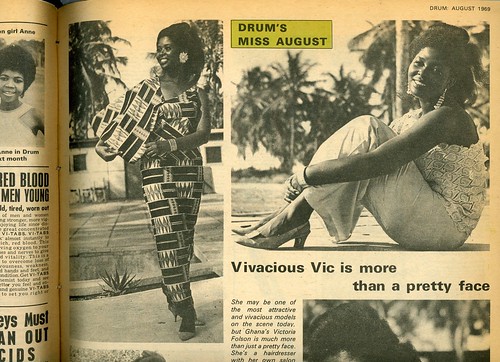
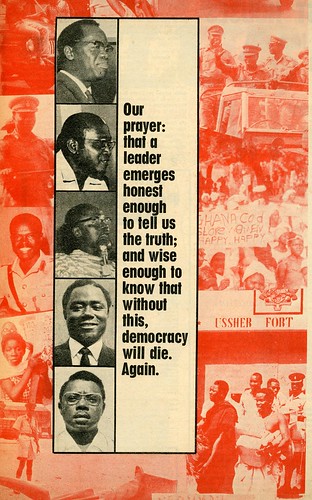
Ghanaian blogger Koranteng Ofosu-Amaah managed to scan a years worth (1969 to be exact) of images from the Ghanaian edition of Drum magazine and post them on his blog with commentary. The mise-en-scène is of an affluent society interested in both socialism and mini skirts, traditional wear and sex education, international politics and the end of Ghanaian one party rule.
But Drum was actually a South African magazine (read about it here) with franchises around the continent. A quick search led to an exhibition of images from the South African edition 1976-1980 which, it turns out, is far more lurid with photo essays documenting stabbings, war, and social unrest. This is the difference, I suppose, between Ghana 1969 and South Africa during the most vicious days of apartheid.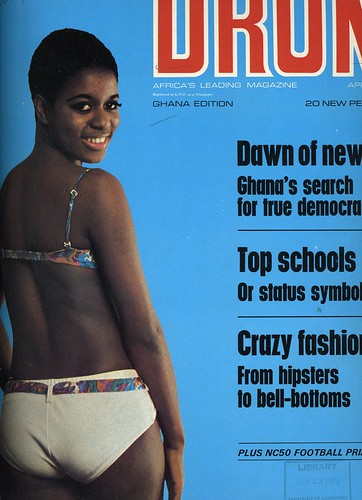



But Drum was actually a South African magazine (read about it here) with franchises around the continent. A quick search led to an exhibition of images from the South African edition 1976-1980 which, it turns out, is far more lurid with photo essays documenting stabbings, war, and social unrest. This is the difference, I suppose, between Ghana 1969 and South Africa during the most vicious days of apartheid.
Wednesday, May 27, 2009
A really nice album cover
 There's a soft feeling I get when I'm taking public transport in a foreign city where I listen to people's conversations, check out people checking out other people, and just become part of the crowd.
This album cover reminds me of taking the train into central Cape Town after visiting a friend in the suburbs. It was full of people just off work: construction workers joking in Xhosa with that distinctive low click that somehow cuts through the noise of Afrikaans speaking kids coming home after a day at the beach.
Sunday, May 3, 2009

Friday, May 1, 2009
Aaron: Resurrection

To all five of you, I'm very sorry to have let this blog lapse. Hopefully the photos from my trip will more than make up for my two months of silence.
Saturday, February 14, 2009
Packing up

I've been running around Lusaka trying to get stuff done before leaving on Tuesday. As Louis likes to point out, the Canadian International Development Agency only funds development between July and February leaving the rest of the year to the free market (jokes) and so I go. I'm taking the train east to Dar armed with a tent, a swim suit and Tanzanian multiple entry visa.
The photo is of Soweto market last week. It's one of the biggest markets in Lusaka and only blocks away from the financial buildings on Cairo road. By comparison, the week before in Harare I went to their largest street market in what was apparently a township slum (it looked like a London council estate). Not only were the streets paved but our Zimbabwean friend pointed to a three square meter puddle and gave a soliloquy on just how far our once great country has fallen.
In a different conversation, with a Zimbabwean web developer, I mentioned that it's nice to be in a country (Zimbabwe) where the cops aren't carrying guns and that in Lusaka they all carry AKs with shoelace shoulder straps. "Yeah but that's Africa," he said conflating Zambia, the DRC and Sudan into one homogeneous northern mass." I told him, you realise the entire BBC/CNN watching world thinks your country is in the middle of some Rawandodarfurian death match to which he just looked puzzled.
Tuesday, February 10, 2009


Monday, February 9, 2009
The hundred billion dollar contest: Where am I?
The person who can name the city I'm in based on these photographs gets one hundred billion dollars.


Thursday, January 22, 2009


Wednesday, January 21, 2009


Monday, January 19, 2009


Windhoek and Swakopmund
I'm just now realising the wonders of resizing one's photos before attempting to upload them on a dodgy satellite connection. It does make them a little less pretty but saves me hours of failed upload attempts.
 Although my friends who've lived there will, I'm sure, call me naive, entering Namibia from Zambia felt a bit like entering the European Union. The border crossing at Katima Mulilo involves a sweaty shoving match in a concrete hut on the Zambian side but complete serenity on the Namibian side. The building above is not the border but a church in the seaside resort town of Swakopmund. So are the next few.

 I was excited to see curbs in Namibia but bike lanes?
 This is central Windhoek, probably the cleanest most inoffensive city I've ever encountered anywhere ever. Of course, that's through the tourist's lens and I'm sure someone will correct me. This church, by the way, stands at the confluence of, I think, Robert Mugabe Avenue and Fidel Castro.
 I traded this man, who by the way is a Namibian of German descent if it isn't obvious by the moustache, one hundred billion Zimbabwean dollars for one Zimbabwean cent. Though economists will tell you both denominations are equally worthless as money I think I got the better deal.
 Although my friends who've lived there will, I'm sure, call me naive, entering Namibia from Zambia felt a bit like entering the European Union. The border crossing at Katima Mulilo involves a sweaty shoving match in a concrete hut on the Zambian side but complete serenity on the Namibian side. The building above is not the border but a church in the seaside resort town of Swakopmund. So are the next few.
 I was excited to see curbs in Namibia but bike lanes?
 This is central Windhoek, probably the cleanest most inoffensive city I've ever encountered anywhere ever. Of course, that's through the tourist's lens and I'm sure someone will correct me. This church, by the way, stands at the confluence of, I think, Robert Mugabe Avenue and Fidel Castro.
 I traded this man, who by the way is a Namibian of German descent if it isn't obvious by the moustache, one hundred billion Zimbabwean dollars for one Zimbabwean cent. Though economists will tell you both denominations are equally worthless as money I think I got the better deal.
Inexplicably fast internet
After months of brutally slow internet it seems to be going very quickly tonight. This will allow me to post all the shameless tourist snaps that have until now been lost to the "your connection has been reset" demons. The next five photos are of my illegal tour of the edge of Victoria falls. This was probably the scariest thing I've ever done. No mom, I was never in any real danger although my guide was the way he jumped around from rock to rock.


Thursday, December 4, 2008
Baby Hawk on My Path
I don't really know how he got there but this little dude lunged at me this morning as I walked to the kitchen in the rain. He continued his assault as I took these photos. After he rain stopped he just disappeared. Everyone thought he must be a baby, including the maid's son who tried to pick him up but was too spooked by his snapping beak. My house-mate said that was the kind of bird that steals chickens.


Subscribe to:
Posts (Atom)


